 |
| fav france 9 |
Thursday, July 24, 2008


France
I am sorry for the long absence from my blog I have been very busy. So I finally got around to selecting my favorite photos of my trip to France, Enjoy....
 |
| farovites of france 1 |
Friday, May 16, 2008
Fun with Fiji water
 |
| sillies |
I don't know if everyone knows this about me but I love to peel labels off things, my two most favorite things to peel are costco price tags off there books and the labels on my art journals. But now I have a new 3rd favorite label to peel, the fiji water label which leaves a excellent sticky area on the bottle!!!!! This can create a lot of fun...
Our t-shirt project
We decided to start a line of t-shirts that show case Fijian tradition tattoo designs. This is our first shirt...
 |
| tattoo shirt |

Stan the softy
 |
| stans babies |
He does not like to see the dogs uncomfortable and Bowser hates getting wet where Cathlene does not care in the least!
Friday, April 18, 2008
Introducing Like a Lady
I meet a wonderful man while I lived in Tonga (check the beginning of the blog and you will see the adventures of Jay and Brian) Brian and he helped me so much. I don't know if I would have survived Tonga without him! He was there as a peace corp volunteer but his background is in film. He became very interested in the Fakaleiti's of Tonga and wanted to create a documentary about them. So one thing lead to another and the beginnings of a documentary was born! Brian is heading back to Tonga this summer to finish his film!!!
Fakaleiti Like a Lady
congratulations Brian!
Fakaleiti Like a Lady
congratulations Brian!
Friday, April 11, 2008


gardens everywhere
Our Tomatoes are just starting to turn color, the beans are flowering, and the bank across the park is being cultivate for cassava.
 |
| tomatoes |
Tuesday, April 08, 2008
Finally!!!!
I am unblocked!!!!!!!! Josie causally mentioned that she would like to do art tonight and that she specifically felt like doing some prints. I think she had a master plan to help get me unstuck!!!! and it did!!!! I am now totally stoked on my new series!!!! drum roll please.....
SEED PODS:
I love printing, I love monoprints! I started my evening trying to be more painterly but that did not really work out. So I went back to the scratching (which I love and do a lot with my pottery!) and nudes but that was uninspiring so I decided to try my other love; seed pods! It totally worked and now I am in a seed pod groove!
Thank God and Thank Josie from bring me back from my dry barren oasis of non-creativity.
SEED PODS:
 |
| monoprints seed pods |
I love printing, I love monoprints! I started my evening trying to be more painterly but that did not really work out. So I went back to the scratching (which I love and do a lot with my pottery!) and nudes but that was uninspiring so I decided to try my other love; seed pods! It totally worked and now I am in a seed pod groove!
Thank God and Thank Josie from bring me back from my dry barren oasis of non-creativity.
Sunday, April 06, 2008
tomatoes and basil
now if we could only get some really good mozzarella!!! we could make a perfect bruschetta!
 |
| gardening 2 |

Friday, March 28, 2008
Oceania dance performance
Went to an Oceania dance performance last night and here are the fuzzy pictures....
We were asked not to use any flash photography hence fuzzy pictures :(
 |
| dance |
We were asked not to use any flash photography hence fuzzy pictures :(

Roc market
The Roc market happens once a month and it is sort of an artisan/home baking/junk market. Josie and I were working our butts off to get some t-shirts done to show case at the market. However Fiji had other plans for us so it still has not happened. Fiji could benefit from a customer service course.
 |
| rock market |
Saturday, March 22, 2008


Easter dinner pre event!
Josie and Chris have been doing prep and cooking for a good portion of the day and now we are getting ready to serve the dinner! We did have sometime to get ready for the rock market (thats another story) and to play some games!
 |
| easter dinner prep |
Easter dinner day
Random shots of our day with Josie and the girls... and the dogs... and insects!
 |
| easter day random shots |
Monday, March 17, 2008
Sunday, March 16, 2008
An Island of Plastic!
Story from the Independent:
The world's rubbish dump: a garbage tip that stretches from Hawaii to Japan
By Kathy Marks, Asia-Pacific Correspondent, and Daniel Howden
Tuesday, 5 February 2008
A "plastic soup" of waste floating in the Pacific Ocean is growing at an alarming rate and now covers an area twice the size of the continental United States, scientists have said.
The vast expanse of debris – in effect the world's largest rubbish dump – is held in place by swirling underwater currents. This drifting "soup" stretches from about 500 nautical miles off the Californian coast, across the northern Pacific, past Hawaii and almost as far as Japan.

Charles Moore, an American oceanographer who discovered the "Great Pacific Garbage Patch" or "trash vortex", believes that about 100 million tons of flotsam are circulating in the region. Marcus Eriksen, a research director of the US-based Algalita Marine Research Foundation, which Mr Moore founded, said yesterday: "The original idea that people had was that it was an island of plastic garbage that you could almost walk on. It is not quite like that. It is almost like a plastic soup. It is endless for an area that is maybe twice the size as continental United States."
Curtis Ebbesmeyer, an oceanographer and leading authority on flotsam, has tracked the build-up of plastics in the seas for more than 15 years and compares the trash vortex to a living entity: "It moves around like a big animal without a leash." When that animal comes close to land, as it does at the Hawaiian archipelago, the results are dramatic. "The garbage patch barfs, and you get a beach covered with this confetti of plastic," he added.
The "soup" is actually two linked areas, either side of the islands of Hawaii, known as the Western and Eastern Pacific Garbage Patches. About one-fifth of the junk – which includes everything from footballs and kayaks to Lego blocks and carrier bags – is thrown off ships or oil platforms. The rest comes from land.
Mr Moore, a former sailor, came across the sea of waste by chance in 1997, while taking a short cut home from a Los Angeles to Hawaii yacht race. He had steered his craft into the "North Pacific gyre" – a vortex where the ocean circulates slowly because of little wind and extreme high pressure systems. Usually sailors avoid it.
He was astonished to find himself surrounded by rubbish, day after day, thousands of miles from land. "Every time I came on deck, there was trash floating by," he said in an interview. "How could we have fouled such a huge area? How could this go on for a week?"
Mr Moore, the heir to a family fortune from the oil industry, subsequently sold his business interests and became an environmental activist. He warned yesterday that unless consumers cut back on their use of disposable plastics, the plastic stew would double in size over the next decade.
Professor David Karl, an oceanographer at the University of Hawaii, said more research was needed to establish the size and nature of the plastic soup but that there was "no reason to doubt" Algalita's findings.
"After all, the plastic trash is going somewhere and it is about time we get a full accounting of the distribution of plastic in the marine ecosystem and especially its fate and impact on marine ecosystems."
Professor Karl is co-ordinating an expedition with Algalita in search of the garbage patch later this year and believes the expanse of junk actually represents a new habitat. Historically, rubbish that ends up in oceanic gyres has biodegraded. But modern plastics are so durable that objects half-a-century old have been found in the north Pacific dump. "Every little piece of plastic manufactured in the past 50 years that made it into the ocean is still out there somewhere," said Tony Andrady, a chemist with the US-based Research Triangle Institute.
Mr Moore said that because the sea of rubbish is translucent and lies just below the water's surface, it is not detectable in satellite photographs. "You only see it from the bows of ships," he said.
According to the UN Environment Programme, plastic debris causes the deaths of more than a million seabirds every year, as well as more than 100,000 marine mammals. Syringes, cigarette lighters and toothbrushes have been found inside the stomachs of dead seabirds, which mistake them for food.
Plastic is believed to constitute 90 per cent of all rubbish floating in the oceans. The UN Environment Programme estimated in 2006 that every square mile of ocean contains 46,000 pieces of floating plastic,
Dr Eriksen said the slowly rotating mass of rubbish-laden water poses a risk to human health, too. Hundreds of millions of tiny plastic pellets, or nurdles – the raw materials for the plastic industry – are lost or spilled every year, working their way into the sea. These pollutants act as chemical sponges attracting man-made chemicals such as hydrocarbons and the pesticide DDT. They then enter the food chain. "What goes into the ocean goes into these animals and onto your dinner plate. It's that simple," said Dr Eriksen.
The world's rubbish dump: a garbage tip that stretches from Hawaii to Japan
By Kathy Marks, Asia-Pacific Correspondent, and Daniel Howden
Tuesday, 5 February 2008
A "plastic soup" of waste floating in the Pacific Ocean is growing at an alarming rate and now covers an area twice the size of the continental United States, scientists have said.
The vast expanse of debris – in effect the world's largest rubbish dump – is held in place by swirling underwater currents. This drifting "soup" stretches from about 500 nautical miles off the Californian coast, across the northern Pacific, past Hawaii and almost as far as Japan.

Charles Moore, an American oceanographer who discovered the "Great Pacific Garbage Patch" or "trash vortex", believes that about 100 million tons of flotsam are circulating in the region. Marcus Eriksen, a research director of the US-based Algalita Marine Research Foundation, which Mr Moore founded, said yesterday: "The original idea that people had was that it was an island of plastic garbage that you could almost walk on. It is not quite like that. It is almost like a plastic soup. It is endless for an area that is maybe twice the size as continental United States."
Curtis Ebbesmeyer, an oceanographer and leading authority on flotsam, has tracked the build-up of plastics in the seas for more than 15 years and compares the trash vortex to a living entity: "It moves around like a big animal without a leash." When that animal comes close to land, as it does at the Hawaiian archipelago, the results are dramatic. "The garbage patch barfs, and you get a beach covered with this confetti of plastic," he added.
The "soup" is actually two linked areas, either side of the islands of Hawaii, known as the Western and Eastern Pacific Garbage Patches. About one-fifth of the junk – which includes everything from footballs and kayaks to Lego blocks and carrier bags – is thrown off ships or oil platforms. The rest comes from land.
Mr Moore, a former sailor, came across the sea of waste by chance in 1997, while taking a short cut home from a Los Angeles to Hawaii yacht race. He had steered his craft into the "North Pacific gyre" – a vortex where the ocean circulates slowly because of little wind and extreme high pressure systems. Usually sailors avoid it.
He was astonished to find himself surrounded by rubbish, day after day, thousands of miles from land. "Every time I came on deck, there was trash floating by," he said in an interview. "How could we have fouled such a huge area? How could this go on for a week?"
Mr Moore, the heir to a family fortune from the oil industry, subsequently sold his business interests and became an environmental activist. He warned yesterday that unless consumers cut back on their use of disposable plastics, the plastic stew would double in size over the next decade.
Professor David Karl, an oceanographer at the University of Hawaii, said more research was needed to establish the size and nature of the plastic soup but that there was "no reason to doubt" Algalita's findings.
"After all, the plastic trash is going somewhere and it is about time we get a full accounting of the distribution of plastic in the marine ecosystem and especially its fate and impact on marine ecosystems."
Professor Karl is co-ordinating an expedition with Algalita in search of the garbage patch later this year and believes the expanse of junk actually represents a new habitat. Historically, rubbish that ends up in oceanic gyres has biodegraded. But modern plastics are so durable that objects half-a-century old have been found in the north Pacific dump. "Every little piece of plastic manufactured in the past 50 years that made it into the ocean is still out there somewhere," said Tony Andrady, a chemist with the US-based Research Triangle Institute.
Mr Moore said that because the sea of rubbish is translucent and lies just below the water's surface, it is not detectable in satellite photographs. "You only see it from the bows of ships," he said.
According to the UN Environment Programme, plastic debris causes the deaths of more than a million seabirds every year, as well as more than 100,000 marine mammals. Syringes, cigarette lighters and toothbrushes have been found inside the stomachs of dead seabirds, which mistake them for food.
Plastic is believed to constitute 90 per cent of all rubbish floating in the oceans. The UN Environment Programme estimated in 2006 that every square mile of ocean contains 46,000 pieces of floating plastic,
Dr Eriksen said the slowly rotating mass of rubbish-laden water poses a risk to human health, too. Hundreds of millions of tiny plastic pellets, or nurdles – the raw materials for the plastic industry – are lost or spilled every year, working their way into the sea. These pollutants act as chemical sponges attracting man-made chemicals such as hydrocarbons and the pesticide DDT. They then enter the food chain. "What goes into the ocean goes into these animals and onto your dinner plate. It's that simple," said Dr Eriksen.

paradise lost
I feel very blessed to be living in a tropical paradise, but there are somethings that are not so beautiful...
1) drowning in a sea of garbage, not only on the streets but in the harbour as well
2) packs of dogs that can make you walks/bike riding a nightmare not to mention how hard it is for them
3) mange/ticks/poisoning just to mention a few
4) lack of water and sanitation in settlements
5) I could go on but I feel the pictures say a thousand words...
1) drowning in a sea of garbage, not only on the streets but in the harbour as well
2) packs of dogs that can make you walks/bike riding a nightmare not to mention how hard it is for them
3) mange/ticks/poisoning just to mention a few
4) lack of water and sanitation in settlements
5) I could go on but I feel the pictures say a thousand words...
 |
| paradise lost |

garden update
We got a lot done this week. We finally got back to the garden and replanted some of the seeds that we lost during the cyclone. The beans have already taken off and the carrots are doing great. We have little tomatoes starting and the lettuce is just starting to sprout!
 |
| garden update |
garden art
Well it has been months since I had the art show at the oceanic art centre, and my bamboo has been lying on the ground at our compound ever since. This weekend somehow the ball started rolling with a walk to the local hardware store, only to find it closed. We wanted to buy sticks for the tomatoes but ended up putting up the bamboo by using the left over pvc pipe I bought for the washing machine!!! It has made a mark on the neighborhood, some people walk by looking but not wanting anyone knowing that they are looking and others just stop and take it in. I have to say last night it looked beautifully illuminated by the gate lights.
 |
| garden art |
Thursday, March 13, 2008
Auction
I was asked to donate a piece of art work to be auctioned off, the money going to a scholarship to support women that want to go into alternative careers. In Fiji that can mean going into Engineering! Still considered an alternative career option in Fiji, scary. The night went well, we got to listen to some amazing poetry, singing and enjoy some wine donated by Victoria Wines. Another interesting experience for the evening was two Fijian performers stating that they are gay! Not done here in Fiji at all!!! You can be an effeminate man that dresses like a woman in Fiji but to be a outright gay man or woman is not an occurrence that happens very often. This is actual the first time I have heard someone declare themselves gay in the South Pacific and I have lived here for 2 years! It happened the next night at the take back the night as well!
 |
| auction night |
Monday, March 10, 2008
International Womans day
I have to admit that I have never been active in the Take Back the Night Campaign, I come from a part of the world where I as a woman have equality (to an extent); but now that I live in a developing country I have a greater understanding of how the majority of the women on this plant struggle everyday. That the majority of the women are impoverished in so many ways. I will be forever changed by living here and how I see myself in a global context of women.
Here are some pictures from the rally that happened in Suva and pictures of rallies from all over the world!
Here are some pictures from the rally that happened in Suva and pictures of rallies from all over the world!
 |
| take back the night |
Wednesday, March 05, 2008
Stan back from Japan!
Stan is finally home after being in Japan for 6 weeks. He can home a bit battered. He was constantly cold in Japan and was wear a lot of cloths on the plane and consequently fainted twice on the plane! He looked bad when he got off the plane in Suva, when we got home I feed him and sent him to bed to sleep! He woke up feeling much better!
| japan |
Saturday, February 23, 2008
baskets
I love learning new crafts especially from the crafts people from the country you are living in or visiting. There was a week long indigenous craft show in Sakuna Park. So Josie and I went to check it out, there were suppose to be workshops but we could not get any info of when or where. I fell in love with this womans baskets, she is from Tuvalu but living in Fiji. Josie asked if we (me) could learn how to make a basket from her and she said yes. So I went and hung out with her for a couple of days and learned the basics of basket weaving!
 |
| art at the park |
A little bit of home
I love ferns and they were a major part of my garden in Canada, along with a great collection of trilliums. I have been looking at ferns here in Fiji and wondering how I can put them in my garden. I finally decided to make a garden in a shading part of the yard. Artificial shade but at this point who cares. Ana and her husband helped me and she was a bit perplexed by my not wanting any colour or very limited colour in the garden. So I started to explain that when you go hiking in Canada you go into these great forests that have these amazing canopy's and on the forest floor you will have a very lush fern garden, amazingly beautiful albeit green!!! I can assure you I was waxing poetic and I am sure my eyes glazed over and I was wearing a spiritually altered expression on my face as I was talking about my forest walk experiences. But the long and the short of it is that she totally got it! and loves my little side garden that is dedicated to my forest walks in Canada!
 |
| my new garden |
girls night out
Ruths daughter Kate was visiting and she requested a night out on the town. Unfortunatly the club was totally dead, the good thing is we had the dance floor to ourselves.

From left to right: Kate, Ruth, Annie, Josie, Me

From left to right: Kate, Ruth, Annie, Josie, Me
Sunday, February 03, 2008
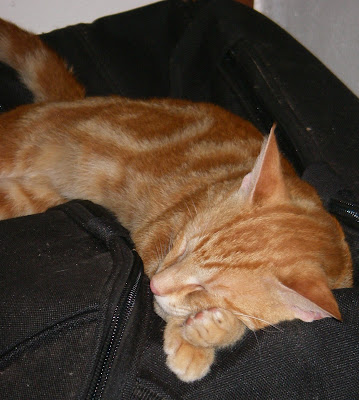
Goodbye Sweet thing...
I am sorry to report that Slinky was killed last night by a pack of stray dogs...

Wednesday, January 30, 2008

blog interuption
I am sorry for not updating the blog, there are two reasons this has happened. One Stan took the camera to Japan and I have not had time to upload his pictures because and this is reason number two we just had a cyclone! It came out of no where on Monday, Josie and I had no clue it was happening, as we were driving back from Nadi, after a weekend of relaxing. We were 30 minutes out of Suva and the winds pick we heard on the news that the storm was coming so we got Josie's girls from school, and then did an emergency supply run to cost u less. Then off home to batten down the hatches. I got Ana's husband to come over and put up the storm shutters, I pulled in all my plants, secured the bamboo art and went inside to collect water in every tub conceivable. Power and water went out that night,I sat up all night so I could stop the water from coming in my front door. 10-15 towels, bed sheets, garbage bags and duck tape later, I was able to stem the flow and get some rest. I woke up with a cold and no water or power. Power came on Tuesday night, water came on today, Thursday but is the color of rust which is understandable. So laundry will have to wait another day!!! or two. Nadi is in much worse shape, under 6 feet of water in some areas and flash flooding from the rivers.

This news article from the Fiji Times:
This about Frozen Food:
Avoid frozen food: Kumar
Thursday, January 31, 2008
STAY away from frozen foods. That's the advice from the Consumer Council of Fiji after extended power cuts across the country.
Council chief executive Premila Kumar said many supermarkets would have been affected by the power cuts in the past two days, which would have affected frozen food items.
"'It is advisable not to purchase thawed products even if the sale price by supermarkets is attractive," she said.
"Once thawed the bacteria on food items and meat can multiply to dangerous levels and possibly cause serious illnesses if consumed.
"'If food in supermarket freezers are soft despite supermarket owners putting their freezer on again, consumers should refrain from purchasing them.
"'Frozen food when thawed also losses its original shape and can help consumers identify if they have been affected by the power outage."
Mrs Kumar urged supermarket owners to be ethical and responsible by destroying all food items and meat that have been affected by flood waters or power cuts.
The council called on the Health Ministry to follow up on the post cyclone clean-up by supermarkets and take appropriate action to prevent the sale of salvaged food and meat products to consumers.
Ministry of Health chief health inspector Waisale Delai also issued a warning against the purchase of frozen goods.
He urged people to thoroughly check frozen foods they buy from shops and supermarkets.
"All defrosted food items such as meat and ice cream must be rejected or disposed of for fear of contamination or food poisoning," he said.
Mr Delai said a team of health inspectors was mobilised on Tuesday to carry out a thorough inspection in all centres.
"They are continuing today (yesterday) and will take all necessary action on their findings after these inspections," he said.
He also advised people to boil all drinking water, especially rain water.
This was a category one cyclone, basically a baby:

This news article from the Fiji Times:
This about Frozen Food:
Avoid frozen food: Kumar
Thursday, January 31, 2008
STAY away from frozen foods. That's the advice from the Consumer Council of Fiji after extended power cuts across the country.
Council chief executive Premila Kumar said many supermarkets would have been affected by the power cuts in the past two days, which would have affected frozen food items.
"'It is advisable not to purchase thawed products even if the sale price by supermarkets is attractive," she said.
"Once thawed the bacteria on food items and meat can multiply to dangerous levels and possibly cause serious illnesses if consumed.
"'If food in supermarket freezers are soft despite supermarket owners putting their freezer on again, consumers should refrain from purchasing them.
"'Frozen food when thawed also losses its original shape and can help consumers identify if they have been affected by the power outage."
Mrs Kumar urged supermarket owners to be ethical and responsible by destroying all food items and meat that have been affected by flood waters or power cuts.
The council called on the Health Ministry to follow up on the post cyclone clean-up by supermarkets and take appropriate action to prevent the sale of salvaged food and meat products to consumers.
Ministry of Health chief health inspector Waisale Delai also issued a warning against the purchase of frozen goods.
He urged people to thoroughly check frozen foods they buy from shops and supermarkets.
"All defrosted food items such as meat and ice cream must be rejected or disposed of for fear of contamination or food poisoning," he said.
Mr Delai said a team of health inspectors was mobilised on Tuesday to carry out a thorough inspection in all centres.
"They are continuing today (yesterday) and will take all necessary action on their findings after these inspections," he said.
He also advised people to boil all drinking water, especially rain water.
This was a category one cyclone, basically a baby:
 |
| cyclone |
Friday, January 11, 2008


Laundry in Suva
Well I have a washing machine but not a dryer, and considering that I live in a hot climate you would think that would be a great thing! But when it has been torrential rains for days you wonder if you will ever be able to do your laundry? Especially before you run out of undies!
 |
| laundry in suva |

Thursday, January 10, 2008
This was sent to me...
Was Nukuleka really the cradle of Polynesia?
10 Jan 2008, 11:36
Auckland, New Zealand:
Editor,
The pronouncement by the prominent Pacific archaeologist, Professor David V. Burley, from Simon Fraser University in Canada, together with his archaeological team of researchers, that the small fishing village of Nukuleka on the northern shores of eastern Tongatapu, at the entrance to the Fanga'uta Lagoon, to be the cradle of Polynesia, let alone the whole of Tonga, does certainly raise a few critical questions of some serious historico-cultural significance (Matangi Tonga, 7 January, '08).
Tonga has, of course, largely been argued by Pacific archaeologists to be the origin of Polynesia, followed by the settlement of Samoa, both in western Polynesia, from where the rest of Polynesia were settled, beginning with the Cook, Marquesas and Society Islands in the central Pacific, then succeeded by Hawai'i in the north, Rapanui (Easter Island) in the east and Aotearoa (New Zealand) in the south, in that order.
This chronology-based argument, as far as western Polynesia goes, was later critically revised, leading to its being replaced with a region-based argument, which propagated the view that at least both Tonga and Samoa were settled relatively at the same time loosely regionally rather than strictly chronologically, i.e., as a region rather than a chronology.
If that was the case, how would the regionally-led argument (and not a chronologically-driven one) affect the local settlement scenario in Tonga? Would Fanga'uta, of which Nukuleka was and is still very much a part, physically, historically and culturally, be considered to have been settled as a single lagoonal area more or less at the same time?
Chronologically speaking, why, then, Nukuleka? But, really, why not Lapaha, 'Alakifonua or Folaha? Or, indeed, why not one of the other many adjoining offshore islands? There must be reasons, most, if not all, of which have remained unanswered. To unearth many, if not all, of these questions would undoubtedly give us a fuller picture of the human history.
Would the truth about Nukuleka solely hinge on the archaeological evidence alone? If not, there is a need for us to bring all the evidence to a convergent point, be they archaeological, linguistic or oral historical. How does, for example, oral history play a role in the scheme of things?
We know for sure that the history of Tonga before the emergence of the Tu'i Tonga is overly symbolically and mythologically represented (in correspondence with the so-called archaeologically and linguistically constructed Lapita society, culture and history), which does not mean (and not an excuse at all) that, because it is highly mythical, it is entirely impossible to make sense of both its complexity and historicity.
With the effective use of heliaki, the refined and sophisticated ephiphoric and metaphoric device for the qualitative and associative formal, substantial and functional exchange between ideas, images and objects in mythology and history, we can surely be able to effectively demarcate between the symbolic and the historical in connection with the human conditions. In effect, the same device can be applied to all forms of formal language, as in oratory, proverbs and poetry.
How does Nukuleka, then, relate to the shifting landscape movement of the Tu'i Tonga, which was mostly confined to Fanga'uta and its adjacent areas, which included an inland coastal-inland turn from 'Alakifonua through Pelehake and Toloa and along the fairly lengthy windward stretch in the southern coasts to Heketa in eastern Tongatapu?
How does Nukuleka stand in relation to Heketa and the shoreline mobility of the Tu'i Tonga from there along the northern coastlines through the Niutao Point (which is opposite Nukuleka) to Lapaha in Mu'a? How is Nukuleka implicated historically and culturally in its close physical proximity to Niutao, where the Langi Tamatou stands?
Was Nukuleka an island, later joined to the Niutao Point, hence its literal meaning "Small-island", in the same way that Nuku'alofa (literally meaning "Island-of-generosity") was connected to mainland Tongatapu in subsequent times? Intentionally or accidently, it is interesting to take note that somehow this particular early landscape movement took place in full circle, both beginning and ending in the Nuku'alofa area.
Was Nuku, the island, named after Leka, the prominent navigator of the Tu'i Tonga? Leka was a toutaivaka, navigator, not a toutaiika, fisherman, although both professions, toutaivaka and toutaiika, were under the generic professional class ha'a toutai. In fact, Ula-mo-Leka, the famous poet-navigator, happened to have combined both navigators of Tu'i Tonga and Tu'i Kanokupolu, i.e., Ula, in his person.
Or, was Leka, the navigator, named after Nukuleka, the small neighbouring island, which was opposite the Niutao Point? Or, was Nukuleka (like the island of Mo'unu opposite Lapaha at later times) merely a safe and convenient anchorage for the imperial fleet of the Tu'i Tonga led by his famous navigator, Leka?
In fact, Kula was the toutaiika of the Tu'i Tonga, and he was based in the Popua-Ma'ufanga area, which was and still is part of Fanga'uta. The word kula, red, in addition to 'uli, black, is prominently featured in Pacific arts, where kula is symbolically man-related, as in kula 'i moana, sunburnt in the ocean, and 'uli 'as in ma'uli, birth-delivering, and moa'uli, courting-go-between, as a female symbol.
Of all the related complex and elaborate beautiful kupesi, geometric designs - such as those used in the arts of tufunga tatatau, tatooing, tufunga ngaohi kulo pottery-making and nimamea'a koka'anga, fine art of bark-cloth-making - which Professor Burley mentioned are, in fact, derived from the master material art of tufunga lalava, line-space-intersecting, kafa sennit-lashing, associated with both tufunga fo'uvaka, boat-building, and tufunga langafale, house-building.
Perhaps the bigger, more important, question would be, How does the kupesi as an significant facet fit in here, as far as the multiplicity of opposed and complementary physical, psychological and social tendencies, characterising the totality of the reality of Tongan society, both synchronically and diachronically?
These artforms were the fatongia, prerogatives, of the so-called hereditary ha'a professional classes, such as ha'a tufunga, class of material artists, ha'a faiva, class of performance artists and ha'a fa'a, class of cultivators, amongst many others. There were class sub-divisions, as in faiva toutaivaka, long-distant navigators and faiva toutaiika, deep-sea fishermen, amidst many others.
The practice of ha'a in the Tu'i Tonga rule was radically scrutinised by the powerful Samoan-led, Tu'i Kanokupolu-informed regime, when it was changed from it being fatongia-based, economically-led, e.g., ha'a tufunga, material artists and ha'a tufunga nimatapu, artists-of-the-handling-of-the-dead, to it being ego-centred, politically-driven, e.g., Ha'a Ngata and Ha'a Havea.
In conclusion, I would also like to throw in a point that is both timely and politically necessary for us all locals and foreigners, academics and non-academics alike, to reflect upon. I refer here to the need to "indigenise" both anthropology and archaeology, not to mention the whole of the disciplinary spectrum vis-�-vis Tonga and the Pacific.
By "indigenisation", as in the case of both Tongan archaeology and anthropology, reference is made to seeing things Tongan as they objectively are, as opposed to their subjective imagining in what we would like them to be. In short, we must observe things Tongan on their own terms rather than by imposing upon them qualities extrinsic to Tongan society, culture and history.
For example, our words for Polynesia and Lapita, imposed by foreigners rather than mediated between them and the locals, are Moana and Pulotu. These local terms are deeply embedded and broadly endowed with sophisticated forms of knowledge, developed carefully and systematically over centuries of life-long, experientially-refining, trial-and-error application and experimentation.
In fact, early ethnographers were correct in classifying Polynesia, literally "many-islands", into western and eastern Polynesia, Pulotu and Havaiki, yet subsequent scholars in the field still fail consciously or unconsciously to recognise that, in terms of local knowledge, the physical, psychological and social dynamics at the interface of this western-eastern divide, can be truly and fruitfully critiqued within the locally-made Pulotu-Havaiki distinction.
Pacific archaeologists, like Pacific linguists, have, for example, come up with the dual marine-based, land-based as characteristic productive and reproductive features of the so-called Lapita social organisation, yet they still refuse to take into account the notion of the kaimoana, kaifonua duality in local understanding and praxis � and many more.
'Ofa atu fau,
Dr 'Okusitino Māhina
Lecturer in Pacific Political Economy & Pacific Arts
Anthropology, University of Auckland, Auckland
New Zealand
and
Director, Vava'u Academy for Critical Inquiry and Applied Research
Tapinga'amaama Campus, Dr 'Okusitino Mahina Education Centre
Tefisi-Nga'akau, Vava'u
Tonga
10 Jan 2008, 11:36
Auckland, New Zealand:
Editor,
The pronouncement by the prominent Pacific archaeologist, Professor David V. Burley, from Simon Fraser University in Canada, together with his archaeological team of researchers, that the small fishing village of Nukuleka on the northern shores of eastern Tongatapu, at the entrance to the Fanga'uta Lagoon, to be the cradle of Polynesia, let alone the whole of Tonga, does certainly raise a few critical questions of some serious historico-cultural significance (Matangi Tonga, 7 January, '08).
Tonga has, of course, largely been argued by Pacific archaeologists to be the origin of Polynesia, followed by the settlement of Samoa, both in western Polynesia, from where the rest of Polynesia were settled, beginning with the Cook, Marquesas and Society Islands in the central Pacific, then succeeded by Hawai'i in the north, Rapanui (Easter Island) in the east and Aotearoa (New Zealand) in the south, in that order.
This chronology-based argument, as far as western Polynesia goes, was later critically revised, leading to its being replaced with a region-based argument, which propagated the view that at least both Tonga and Samoa were settled relatively at the same time loosely regionally rather than strictly chronologically, i.e., as a region rather than a chronology.
If that was the case, how would the regionally-led argument (and not a chronologically-driven one) affect the local settlement scenario in Tonga? Would Fanga'uta, of which Nukuleka was and is still very much a part, physically, historically and culturally, be considered to have been settled as a single lagoonal area more or less at the same time?
Chronologically speaking, why, then, Nukuleka? But, really, why not Lapaha, 'Alakifonua or Folaha? Or, indeed, why not one of the other many adjoining offshore islands? There must be reasons, most, if not all, of which have remained unanswered. To unearth many, if not all, of these questions would undoubtedly give us a fuller picture of the human history.
Would the truth about Nukuleka solely hinge on the archaeological evidence alone? If not, there is a need for us to bring all the evidence to a convergent point, be they archaeological, linguistic or oral historical. How does, for example, oral history play a role in the scheme of things?
We know for sure that the history of Tonga before the emergence of the Tu'i Tonga is overly symbolically and mythologically represented (in correspondence with the so-called archaeologically and linguistically constructed Lapita society, culture and history), which does not mean (and not an excuse at all) that, because it is highly mythical, it is entirely impossible to make sense of both its complexity and historicity.
With the effective use of heliaki, the refined and sophisticated ephiphoric and metaphoric device for the qualitative and associative formal, substantial and functional exchange between ideas, images and objects in mythology and history, we can surely be able to effectively demarcate between the symbolic and the historical in connection with the human conditions. In effect, the same device can be applied to all forms of formal language, as in oratory, proverbs and poetry.
How does Nukuleka, then, relate to the shifting landscape movement of the Tu'i Tonga, which was mostly confined to Fanga'uta and its adjacent areas, which included an inland coastal-inland turn from 'Alakifonua through Pelehake and Toloa and along the fairly lengthy windward stretch in the southern coasts to Heketa in eastern Tongatapu?
How does Nukuleka stand in relation to Heketa and the shoreline mobility of the Tu'i Tonga from there along the northern coastlines through the Niutao Point (which is opposite Nukuleka) to Lapaha in Mu'a? How is Nukuleka implicated historically and culturally in its close physical proximity to Niutao, where the Langi Tamatou stands?
Was Nukuleka an island, later joined to the Niutao Point, hence its literal meaning "Small-island", in the same way that Nuku'alofa (literally meaning "Island-of-generosity") was connected to mainland Tongatapu in subsequent times? Intentionally or accidently, it is interesting to take note that somehow this particular early landscape movement took place in full circle, both beginning and ending in the Nuku'alofa area.
Was Nuku, the island, named after Leka, the prominent navigator of the Tu'i Tonga? Leka was a toutaivaka, navigator, not a toutaiika, fisherman, although both professions, toutaivaka and toutaiika, were under the generic professional class ha'a toutai. In fact, Ula-mo-Leka, the famous poet-navigator, happened to have combined both navigators of Tu'i Tonga and Tu'i Kanokupolu, i.e., Ula, in his person.
Or, was Leka, the navigator, named after Nukuleka, the small neighbouring island, which was opposite the Niutao Point? Or, was Nukuleka (like the island of Mo'unu opposite Lapaha at later times) merely a safe and convenient anchorage for the imperial fleet of the Tu'i Tonga led by his famous navigator, Leka?
In fact, Kula was the toutaiika of the Tu'i Tonga, and he was based in the Popua-Ma'ufanga area, which was and still is part of Fanga'uta. The word kula, red, in addition to 'uli, black, is prominently featured in Pacific arts, where kula is symbolically man-related, as in kula 'i moana, sunburnt in the ocean, and 'uli 'as in ma'uli, birth-delivering, and moa'uli, courting-go-between, as a female symbol.
Of all the related complex and elaborate beautiful kupesi, geometric designs - such as those used in the arts of tufunga tatatau, tatooing, tufunga ngaohi kulo pottery-making and nimamea'a koka'anga, fine art of bark-cloth-making - which Professor Burley mentioned are, in fact, derived from the master material art of tufunga lalava, line-space-intersecting, kafa sennit-lashing, associated with both tufunga fo'uvaka, boat-building, and tufunga langafale, house-building.
Perhaps the bigger, more important, question would be, How does the kupesi as an significant facet fit in here, as far as the multiplicity of opposed and complementary physical, psychological and social tendencies, characterising the totality of the reality of Tongan society, both synchronically and diachronically?
These artforms were the fatongia, prerogatives, of the so-called hereditary ha'a professional classes, such as ha'a tufunga, class of material artists, ha'a faiva, class of performance artists and ha'a fa'a, class of cultivators, amongst many others. There were class sub-divisions, as in faiva toutaivaka, long-distant navigators and faiva toutaiika, deep-sea fishermen, amidst many others.
The practice of ha'a in the Tu'i Tonga rule was radically scrutinised by the powerful Samoan-led, Tu'i Kanokupolu-informed regime, when it was changed from it being fatongia-based, economically-led, e.g., ha'a tufunga, material artists and ha'a tufunga nimatapu, artists-of-the-handling-of-the-dead, to it being ego-centred, politically-driven, e.g., Ha'a Ngata and Ha'a Havea.
In conclusion, I would also like to throw in a point that is both timely and politically necessary for us all locals and foreigners, academics and non-academics alike, to reflect upon. I refer here to the need to "indigenise" both anthropology and archaeology, not to mention the whole of the disciplinary spectrum vis-�-vis Tonga and the Pacific.
By "indigenisation", as in the case of both Tongan archaeology and anthropology, reference is made to seeing things Tongan as they objectively are, as opposed to their subjective imagining in what we would like them to be. In short, we must observe things Tongan on their own terms rather than by imposing upon them qualities extrinsic to Tongan society, culture and history.
For example, our words for Polynesia and Lapita, imposed by foreigners rather than mediated between them and the locals, are Moana and Pulotu. These local terms are deeply embedded and broadly endowed with sophisticated forms of knowledge, developed carefully and systematically over centuries of life-long, experientially-refining, trial-and-error application and experimentation.
In fact, early ethnographers were correct in classifying Polynesia, literally "many-islands", into western and eastern Polynesia, Pulotu and Havaiki, yet subsequent scholars in the field still fail consciously or unconsciously to recognise that, in terms of local knowledge, the physical, psychological and social dynamics at the interface of this western-eastern divide, can be truly and fruitfully critiqued within the locally-made Pulotu-Havaiki distinction.
Pacific archaeologists, like Pacific linguists, have, for example, come up with the dual marine-based, land-based as characteristic productive and reproductive features of the so-called Lapita social organisation, yet they still refuse to take into account the notion of the kaimoana, kaifonua duality in local understanding and praxis � and many more.
'Ofa atu fau,
Dr 'Okusitino Māhina
Lecturer in Pacific Political Economy & Pacific Arts
Anthropology, University of Auckland, Auckland
New Zealand
and
Director, Vava'u Academy for Critical Inquiry and Applied Research
Tapinga'amaama Campus, Dr 'Okusitino Mahina Education Centre
Tefisi-Nga'akau, Vava'u
Tonga
Wednesday, January 09, 2008
Tonga is the birth place of Polynesia!?!?!?
Tongan site dated oldest in Polynesia
By MICHAEL FIELD - Fairfax Media | Thursday, 10 January 2008
A small fishing village established 2900 years ago in Tonga has been confirmed as the first settlement in Polynesia.
Using pottery shards, archaeologist David Burley says they have confirmed Nukuleka, just east of Tonga's capital, Nuku'alofa, is Polynesia's birthplace.
The confirmation comes as something of a blow for Samoa which has advertised itself for decades as the "cradle of Polynesia".
Fiji's Sigatoka dunes have also made claims to be Polynesia's birthplace but they appear now to be several centuries younger.
Archaeologists have focused on Nukuleka for the past five years following the discovery of rich pickings of Lapita pottery.
A distinctive type of pottery, named for the site in New Caledonia where it was first found, was carried through Melanesia and into the Pacific by a mysterious group of people who eventually became the first Polynesians.
Professor Burley, of Simon Fraser University in Canada, told Matangi Tonga website that a final excavation last year had nailed Nukuleka's position as Polynesia's first. The pottery was 2900 years old.
"Tonga was the first group of islands in Polynesia to be settled by the Lapita people about 3000 years ago, and Nukuleka was their first settlement in Tonga," he said.
The site for the village, at the mouth of the Fanga'uta lagoon, was ideal.
"They came here first about 3000 years ago when the lagoon sea level was higher than today.
"There were no mangroves, so the lagoon shore was a big beach, and the lagoon was full of shellfish, and everything that we have dug up was packed with layers of shellfish."
The area was rich in shells and researchers found that the people were eating lots of turtles and birds, he said.
"What we are trying to prove is that this is the first site in Tonga, and everything that we have found verifies that," he said.
Within a century of establishing Nukuleka the first Polynesians had settled the whole of Tonga. "Then a thousand years later they moved eastwards to eastern Polynesia."
By MICHAEL FIELD - Fairfax Media | Thursday, 10 January 2008
A small fishing village established 2900 years ago in Tonga has been confirmed as the first settlement in Polynesia.
Using pottery shards, archaeologist David Burley says they have confirmed Nukuleka, just east of Tonga's capital, Nuku'alofa, is Polynesia's birthplace.
The confirmation comes as something of a blow for Samoa which has advertised itself for decades as the "cradle of Polynesia".
Fiji's Sigatoka dunes have also made claims to be Polynesia's birthplace but they appear now to be several centuries younger.
Archaeologists have focused on Nukuleka for the past five years following the discovery of rich pickings of Lapita pottery.
A distinctive type of pottery, named for the site in New Caledonia where it was first found, was carried through Melanesia and into the Pacific by a mysterious group of people who eventually became the first Polynesians.
Professor Burley, of Simon Fraser University in Canada, told Matangi Tonga website that a final excavation last year had nailed Nukuleka's position as Polynesia's first. The pottery was 2900 years old.
"Tonga was the first group of islands in Polynesia to be settled by the Lapita people about 3000 years ago, and Nukuleka was their first settlement in Tonga," he said.
The site for the village, at the mouth of the Fanga'uta lagoon, was ideal.
"They came here first about 3000 years ago when the lagoon sea level was higher than today.
"There were no mangroves, so the lagoon shore was a big beach, and the lagoon was full of shellfish, and everything that we have dug up was packed with layers of shellfish."
The area was rich in shells and researchers found that the people were eating lots of turtles and birds, he said.
"What we are trying to prove is that this is the first site in Tonga, and everything that we have found verifies that," he said.
Within a century of establishing Nukuleka the first Polynesians had settled the whole of Tonga. "Then a thousand years later they moved eastwards to eastern Polynesia."
Tuesday, January 01, 2008
Kula park
We decided to go away for New Year's to Sandy Point. New Years eve we went to Kula Eco Park. Other than that we spent most of our time swimming and hanging out, reading, and napping. A perfect way to bring in the New Year!
 |
| kula eco park |

Subscribe to:
Posts (Atom)
