 |
| garden art |
Sunday, March 16, 2008
garden art
Well it has been months since I had the art show at the oceanic art centre, and my bamboo has been lying on the ground at our compound ever since. This weekend somehow the ball started rolling with a walk to the local hardware store, only to find it closed. We wanted to buy sticks for the tomatoes but ended up putting up the bamboo by using the left over pvc pipe I bought for the washing machine!!! It has made a mark on the neighborhood, some people walk by looking but not wanting anyone knowing that they are looking and others just stop and take it in. I have to say last night it looked beautifully illuminated by the gate lights.

Thursday, March 13, 2008
Auction
I was asked to donate a piece of art work to be auctioned off, the money going to a scholarship to support women that want to go into alternative careers. In Fiji that can mean going into Engineering! Still considered an alternative career option in Fiji, scary. The night went well, we got to listen to some amazing poetry, singing and enjoy some wine donated by Victoria Wines. Another interesting experience for the evening was two Fijian performers stating that they are gay! Not done here in Fiji at all!!! You can be an effeminate man that dresses like a woman in Fiji but to be a outright gay man or woman is not an occurrence that happens very often. This is actual the first time I have heard someone declare themselves gay in the South Pacific and I have lived here for 2 years! It happened the next night at the take back the night as well!
 |
| auction night |
Monday, March 10, 2008
International Womans day
I have to admit that I have never been active in the Take Back the Night Campaign, I come from a part of the world where I as a woman have equality (to an extent); but now that I live in a developing country I have a greater understanding of how the majority of the women on this plant struggle everyday. That the majority of the women are impoverished in so many ways. I will be forever changed by living here and how I see myself in a global context of women.
Here are some pictures from the rally that happened in Suva and pictures of rallies from all over the world!
Here are some pictures from the rally that happened in Suva and pictures of rallies from all over the world!
 |
| take back the night |
Wednesday, March 05, 2008
Stan back from Japan!
Stan is finally home after being in Japan for 6 weeks. He can home a bit battered. He was constantly cold in Japan and was wear a lot of cloths on the plane and consequently fainted twice on the plane! He looked bad when he got off the plane in Suva, when we got home I feed him and sent him to bed to sleep! He woke up feeling much better!
| japan |
Saturday, February 23, 2008
baskets
I love learning new crafts especially from the crafts people from the country you are living in or visiting. There was a week long indigenous craft show in Sakuna Park. So Josie and I went to check it out, there were suppose to be workshops but we could not get any info of when or where. I fell in love with this womans baskets, she is from Tuvalu but living in Fiji. Josie asked if we (me) could learn how to make a basket from her and she said yes. So I went and hung out with her for a couple of days and learned the basics of basket weaving!
 |
| art at the park |
A little bit of home
I love ferns and they were a major part of my garden in Canada, along with a great collection of trilliums. I have been looking at ferns here in Fiji and wondering how I can put them in my garden. I finally decided to make a garden in a shading part of the yard. Artificial shade but at this point who cares. Ana and her husband helped me and she was a bit perplexed by my not wanting any colour or very limited colour in the garden. So I started to explain that when you go hiking in Canada you go into these great forests that have these amazing canopy's and on the forest floor you will have a very lush fern garden, amazingly beautiful albeit green!!! I can assure you I was waxing poetic and I am sure my eyes glazed over and I was wearing a spiritually altered expression on my face as I was talking about my forest walk experiences. But the long and the short of it is that she totally got it! and loves my little side garden that is dedicated to my forest walks in Canada!
 |
| my new garden |
girls night out
Ruths daughter Kate was visiting and she requested a night out on the town. Unfortunatly the club was totally dead, the good thing is we had the dance floor to ourselves.

From left to right: Kate, Ruth, Annie, Josie, Me

From left to right: Kate, Ruth, Annie, Josie, Me

Sunday, February 03, 2008
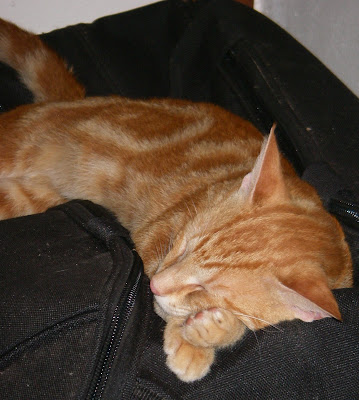
Goodbye Sweet thing...
I am sorry to report that Slinky was killed last night by a pack of stray dogs...

Wednesday, January 30, 2008

blog interuption
I am sorry for not updating the blog, there are two reasons this has happened. One Stan took the camera to Japan and I have not had time to upload his pictures because and this is reason number two we just had a cyclone! It came out of no where on Monday, Josie and I had no clue it was happening, as we were driving back from Nadi, after a weekend of relaxing. We were 30 minutes out of Suva and the winds pick we heard on the news that the storm was coming so we got Josie's girls from school, and then did an emergency supply run to cost u less. Then off home to batten down the hatches. I got Ana's husband to come over and put up the storm shutters, I pulled in all my plants, secured the bamboo art and went inside to collect water in every tub conceivable. Power and water went out that night,I sat up all night so I could stop the water from coming in my front door. 10-15 towels, bed sheets, garbage bags and duck tape later, I was able to stem the flow and get some rest. I woke up with a cold and no water or power. Power came on Tuesday night, water came on today, Thursday but is the color of rust which is understandable. So laundry will have to wait another day!!! or two. Nadi is in much worse shape, under 6 feet of water in some areas and flash flooding from the rivers.

This news article from the Fiji Times:
This about Frozen Food:
Avoid frozen food: Kumar
Thursday, January 31, 2008
STAY away from frozen foods. That's the advice from the Consumer Council of Fiji after extended power cuts across the country.
Council chief executive Premila Kumar said many supermarkets would have been affected by the power cuts in the past two days, which would have affected frozen food items.
"'It is advisable not to purchase thawed products even if the sale price by supermarkets is attractive," she said.
"Once thawed the bacteria on food items and meat can multiply to dangerous levels and possibly cause serious illnesses if consumed.
"'If food in supermarket freezers are soft despite supermarket owners putting their freezer on again, consumers should refrain from purchasing them.
"'Frozen food when thawed also losses its original shape and can help consumers identify if they have been affected by the power outage."
Mrs Kumar urged supermarket owners to be ethical and responsible by destroying all food items and meat that have been affected by flood waters or power cuts.
The council called on the Health Ministry to follow up on the post cyclone clean-up by supermarkets and take appropriate action to prevent the sale of salvaged food and meat products to consumers.
Ministry of Health chief health inspector Waisale Delai also issued a warning against the purchase of frozen goods.
He urged people to thoroughly check frozen foods they buy from shops and supermarkets.
"All defrosted food items such as meat and ice cream must be rejected or disposed of for fear of contamination or food poisoning," he said.
Mr Delai said a team of health inspectors was mobilised on Tuesday to carry out a thorough inspection in all centres.
"They are continuing today (yesterday) and will take all necessary action on their findings after these inspections," he said.
He also advised people to boil all drinking water, especially rain water.
This was a category one cyclone, basically a baby:
 |
| cyclone |
Friday, January 11, 2008


Laundry in Suva
Well I have a washing machine but not a dryer, and considering that I live in a hot climate you would think that would be a great thing! But when it has been torrential rains for days you wonder if you will ever be able to do your laundry? Especially before you run out of undies!
 |
| laundry in suva |

Thursday, January 10, 2008
This was sent to me...
Was Nukuleka really the cradle of Polynesia?
10 Jan 2008, 11:36
Auckland, New Zealand:
Editor,
The pronouncement by the prominent Pacific archaeologist, Professor David V. Burley, from Simon Fraser University in Canada, together with his archaeological team of researchers, that the small fishing village of Nukuleka on the northern shores of eastern Tongatapu, at the entrance to the Fanga'uta Lagoon, to be the cradle of Polynesia, let alone the whole of Tonga, does certainly raise a few critical questions of some serious historico-cultural significance (Matangi Tonga, 7 January, '08).
Tonga has, of course, largely been argued by Pacific archaeologists to be the origin of Polynesia, followed by the settlement of Samoa, both in western Polynesia, from where the rest of Polynesia were settled, beginning with the Cook, Marquesas and Society Islands in the central Pacific, then succeeded by Hawai'i in the north, Rapanui (Easter Island) in the east and Aotearoa (New Zealand) in the south, in that order.
This chronology-based argument, as far as western Polynesia goes, was later critically revised, leading to its being replaced with a region-based argument, which propagated the view that at least both Tonga and Samoa were settled relatively at the same time loosely regionally rather than strictly chronologically, i.e., as a region rather than a chronology.
If that was the case, how would the regionally-led argument (and not a chronologically-driven one) affect the local settlement scenario in Tonga? Would Fanga'uta, of which Nukuleka was and is still very much a part, physically, historically and culturally, be considered to have been settled as a single lagoonal area more or less at the same time?
Chronologically speaking, why, then, Nukuleka? But, really, why not Lapaha, 'Alakifonua or Folaha? Or, indeed, why not one of the other many adjoining offshore islands? There must be reasons, most, if not all, of which have remained unanswered. To unearth many, if not all, of these questions would undoubtedly give us a fuller picture of the human history.
Would the truth about Nukuleka solely hinge on the archaeological evidence alone? If not, there is a need for us to bring all the evidence to a convergent point, be they archaeological, linguistic or oral historical. How does, for example, oral history play a role in the scheme of things?
We know for sure that the history of Tonga before the emergence of the Tu'i Tonga is overly symbolically and mythologically represented (in correspondence with the so-called archaeologically and linguistically constructed Lapita society, culture and history), which does not mean (and not an excuse at all) that, because it is highly mythical, it is entirely impossible to make sense of both its complexity and historicity.
With the effective use of heliaki, the refined and sophisticated ephiphoric and metaphoric device for the qualitative and associative formal, substantial and functional exchange between ideas, images and objects in mythology and history, we can surely be able to effectively demarcate between the symbolic and the historical in connection with the human conditions. In effect, the same device can be applied to all forms of formal language, as in oratory, proverbs and poetry.
How does Nukuleka, then, relate to the shifting landscape movement of the Tu'i Tonga, which was mostly confined to Fanga'uta and its adjacent areas, which included an inland coastal-inland turn from 'Alakifonua through Pelehake and Toloa and along the fairly lengthy windward stretch in the southern coasts to Heketa in eastern Tongatapu?
How does Nukuleka stand in relation to Heketa and the shoreline mobility of the Tu'i Tonga from there along the northern coastlines through the Niutao Point (which is opposite Nukuleka) to Lapaha in Mu'a? How is Nukuleka implicated historically and culturally in its close physical proximity to Niutao, where the Langi Tamatou stands?
Was Nukuleka an island, later joined to the Niutao Point, hence its literal meaning "Small-island", in the same way that Nuku'alofa (literally meaning "Island-of-generosity") was connected to mainland Tongatapu in subsequent times? Intentionally or accidently, it is interesting to take note that somehow this particular early landscape movement took place in full circle, both beginning and ending in the Nuku'alofa area.
Was Nuku, the island, named after Leka, the prominent navigator of the Tu'i Tonga? Leka was a toutaivaka, navigator, not a toutaiika, fisherman, although both professions, toutaivaka and toutaiika, were under the generic professional class ha'a toutai. In fact, Ula-mo-Leka, the famous poet-navigator, happened to have combined both navigators of Tu'i Tonga and Tu'i Kanokupolu, i.e., Ula, in his person.
Or, was Leka, the navigator, named after Nukuleka, the small neighbouring island, which was opposite the Niutao Point? Or, was Nukuleka (like the island of Mo'unu opposite Lapaha at later times) merely a safe and convenient anchorage for the imperial fleet of the Tu'i Tonga led by his famous navigator, Leka?
In fact, Kula was the toutaiika of the Tu'i Tonga, and he was based in the Popua-Ma'ufanga area, which was and still is part of Fanga'uta. The word kula, red, in addition to 'uli, black, is prominently featured in Pacific arts, where kula is symbolically man-related, as in kula 'i moana, sunburnt in the ocean, and 'uli 'as in ma'uli, birth-delivering, and moa'uli, courting-go-between, as a female symbol.
Of all the related complex and elaborate beautiful kupesi, geometric designs - such as those used in the arts of tufunga tatatau, tatooing, tufunga ngaohi kulo pottery-making and nimamea'a koka'anga, fine art of bark-cloth-making - which Professor Burley mentioned are, in fact, derived from the master material art of tufunga lalava, line-space-intersecting, kafa sennit-lashing, associated with both tufunga fo'uvaka, boat-building, and tufunga langafale, house-building.
Perhaps the bigger, more important, question would be, How does the kupesi as an significant facet fit in here, as far as the multiplicity of opposed and complementary physical, psychological and social tendencies, characterising the totality of the reality of Tongan society, both synchronically and diachronically?
These artforms were the fatongia, prerogatives, of the so-called hereditary ha'a professional classes, such as ha'a tufunga, class of material artists, ha'a faiva, class of performance artists and ha'a fa'a, class of cultivators, amongst many others. There were class sub-divisions, as in faiva toutaivaka, long-distant navigators and faiva toutaiika, deep-sea fishermen, amidst many others.
The practice of ha'a in the Tu'i Tonga rule was radically scrutinised by the powerful Samoan-led, Tu'i Kanokupolu-informed regime, when it was changed from it being fatongia-based, economically-led, e.g., ha'a tufunga, material artists and ha'a tufunga nimatapu, artists-of-the-handling-of-the-dead, to it being ego-centred, politically-driven, e.g., Ha'a Ngata and Ha'a Havea.
In conclusion, I would also like to throw in a point that is both timely and politically necessary for us all locals and foreigners, academics and non-academics alike, to reflect upon. I refer here to the need to "indigenise" both anthropology and archaeology, not to mention the whole of the disciplinary spectrum vis-�-vis Tonga and the Pacific.
By "indigenisation", as in the case of both Tongan archaeology and anthropology, reference is made to seeing things Tongan as they objectively are, as opposed to their subjective imagining in what we would like them to be. In short, we must observe things Tongan on their own terms rather than by imposing upon them qualities extrinsic to Tongan society, culture and history.
For example, our words for Polynesia and Lapita, imposed by foreigners rather than mediated between them and the locals, are Moana and Pulotu. These local terms are deeply embedded and broadly endowed with sophisticated forms of knowledge, developed carefully and systematically over centuries of life-long, experientially-refining, trial-and-error application and experimentation.
In fact, early ethnographers were correct in classifying Polynesia, literally "many-islands", into western and eastern Polynesia, Pulotu and Havaiki, yet subsequent scholars in the field still fail consciously or unconsciously to recognise that, in terms of local knowledge, the physical, psychological and social dynamics at the interface of this western-eastern divide, can be truly and fruitfully critiqued within the locally-made Pulotu-Havaiki distinction.
Pacific archaeologists, like Pacific linguists, have, for example, come up with the dual marine-based, land-based as characteristic productive and reproductive features of the so-called Lapita social organisation, yet they still refuse to take into account the notion of the kaimoana, kaifonua duality in local understanding and praxis � and many more.
'Ofa atu fau,
Dr 'Okusitino Māhina
Lecturer in Pacific Political Economy & Pacific Arts
Anthropology, University of Auckland, Auckland
New Zealand
and
Director, Vava'u Academy for Critical Inquiry and Applied Research
Tapinga'amaama Campus, Dr 'Okusitino Mahina Education Centre
Tefisi-Nga'akau, Vava'u
Tonga
Wednesday, January 09, 2008
Tonga is the birth place of Polynesia!?!?!?
Tongan site dated oldest in Polynesia
By MICHAEL FIELD - Fairfax Media | Thursday, 10 January 2008
A small fishing village established 2900 years ago in Tonga has been confirmed as the first settlement in Polynesia.
Using pottery shards, archaeologist David Burley says they have confirmed Nukuleka, just east of Tonga's capital, Nuku'alofa, is Polynesia's birthplace.
The confirmation comes as something of a blow for Samoa which has advertised itself for decades as the "cradle of Polynesia".
Fiji's Sigatoka dunes have also made claims to be Polynesia's birthplace but they appear now to be several centuries younger.
Archaeologists have focused on Nukuleka for the past five years following the discovery of rich pickings of Lapita pottery.
A distinctive type of pottery, named for the site in New Caledonia where it was first found, was carried through Melanesia and into the Pacific by a mysterious group of people who eventually became the first Polynesians.
Professor Burley, of Simon Fraser University in Canada, told Matangi Tonga website that a final excavation last year had nailed Nukuleka's position as Polynesia's first. The pottery was 2900 years old.
"Tonga was the first group of islands in Polynesia to be settled by the Lapita people about 3000 years ago, and Nukuleka was their first settlement in Tonga," he said.
The site for the village, at the mouth of the Fanga'uta lagoon, was ideal.
"They came here first about 3000 years ago when the lagoon sea level was higher than today.
"There were no mangroves, so the lagoon shore was a big beach, and the lagoon was full of shellfish, and everything that we have dug up was packed with layers of shellfish."
The area was rich in shells and researchers found that the people were eating lots of turtles and birds, he said.
"What we are trying to prove is that this is the first site in Tonga, and everything that we have found verifies that," he said.
Within a century of establishing Nukuleka the first Polynesians had settled the whole of Tonga. "Then a thousand years later they moved eastwards to eastern Polynesia."
Tuesday, January 01, 2008
Kula park
We decided to go away for New Year's to Sandy Point. New Years eve we went to Kula Eco Park. Other than that we spent most of our time swimming and hanging out, reading, and napping. A perfect way to bring in the New Year!
 |
| kula eco park |

Tuesday, December 25, 2007
Christmas day
Unwrapping gifts and water fights!!!! The girls decided that they did not want bought gifts from Chris and Josie this year. They wanted to give gifts to Jorji the squatter across the street, gifts to the deaf school, and school supplies to an orphanage. I tried to follow suit and gave some hand made gifts as well.
 |
| christmas day |

PNG bag
My new acquisition my png billum bag!!!! made with cuscus fur or a possum-like nocturnal marsupials they call a tree kangaroo.
A billum or bilum is a traditional hand-made Papua New Guinea bag. It is usually used for carrying foods, firewood or even babies
Originally billums were made from tree bark string, however today, Papua New Guinea women also make bilums from wool and fishing lines
Natural and artificial pigments are used to add colour and style to billums. Some bilums feature intricate designs, and others are decorated with shells, fur or even feathers
 |
| the png bag |
Chaos!
A hurricane has hit the inside of our home! Now the fun begins, the putting away and organizing. The best part of moving is hanging my pictures!!!
 |
| new house getting set up |
Moving!!!!
Stan is home from Tonga and is helping with the last few loads. His friend Nemo is supervising him!
 |
| new house |
Wednesday, December 12, 2007
I am in the Fiji Times!!!

Please ignore the first 8 lines communication break down!!!!

Jens joyous journey with art
EMELINE NAIKALIVOU (Thursday, December 13, 2007)
Jennifer James poses beside one of her paintings
Jennifer James always had a passion for art, particularly painting.
The Canadian simply cannot imagine her life without art as it brings her immense joy.
She recalls her young years when she would draw on anything she got hold of.
Her artistic tendencies are hardly surprising given her families artistic background.
Here family were known for their body sculptures.
So when they learnt she had she had no affinity for the family's past-time passion, they found it odd and were quite taken aback.
And much to their disappointment, Jennifer was so set on becoming an artist.
Common ground was finally reached when parties resolved that she continue her studies in order to secure a better job and only after could she be allowed to become an artist.
Jennifer said she did not have the heart to disappoint her family so she continued and successfully pursued a diploma in physiotherapy.
She now owns a clinic in Canada.
"I had to work in a clinic for six months and then after three months, I opened my very own clinic with the help of my business partner," she proudly relayed.
Today the promising artist from Vancouver is more confident and self-assured.
She is still buzzing from the rush of having 30 of her artwork exhibited at the University of the South Pacific's Oceania Art and Cultural Centre
She was very pleased with the response.
The second-year USPArt student Jennifer says she could not have asked for a better place to master her passion.
"I have come to understand what art is all about," she enthused.
"I was really honoured to have an exhibit in the Oceania Art Centre.
Jennifer says art is not only about putting colours together to make the picture look good.
It is instead a way of expressing feelings, moods and views on a particular subject, she said.
I love to draw something that promotes peace and harmony, she added.
While painting is the ultimate de-stressor for her, nature walks, reading, spending time with friends and baking are also activities she cares to indulge in.
She says young artists should find a good mentor, practice, and above all have fun.
Jennifer laments though that the high cost of painting materials is a restrictive factor to the development of the art.
Resources in this field are very limited, thus very expensive, she said. The tropical weather is also another disadvantage as oil paints take longer to dry in the heat.
The artist says she has unconsciously developed a ritual on how she chooses her paintings.
Whenever she feels the urge to draw she first meditates on the subject.
Normally, the first colour that pops into her head is what she uses to depict her theme.
Each work of art holds special meaning for Jennifer because through each piece, she tries to relay a message. Her work is largely about peace and harmony.
One day she hopes to be able to make a living from her artwork.
My ultimate goal is to open a gallery so that I can support other artists, she said.
Copyright © 2007, Fiji Times Limited. All Rights Reserved.
Sunday, December 09, 2007
Saturday, December 08, 2007
The new flat
I got the KEYS to the new flat!!!! and cleaned it yesterday from top to bottom. In Fiji we get this weird black greasy dust that really settles when a place is left empty. Our feet will show you what I mean, considering the flat was empty for several months it was in ok condition. Some mold growing on some of the walls, very dirty floors and a wasps nest in the bathroom. What we did not get is Mina birds which is great because that is a nightmare!!! During the coup they took residency in Josie's place while they were away. I do have some screens that will need to be replaced since they did try to peck there way into the house. Here are some pictures of our new and very empty flat!!!!! Which will remain bare, we don't want to buy furniture here, I will take some pictures for you one day so you can see why.
 |
| new flat |
Friday, December 07, 2007
Cyclone
Well the cyclone totally missed Suva!!!! But unfortunately it did hit other smaller islands that make up Fiji. One Island was completely flattened and no word if the 2 villages that inhabited the Island survived, they are in our prayers along with the other areas that were hit.
I have been insanely busy, not only with the art show but with also finding a new place to live. The landlord kicked us out because we refused to clean his driveway and we made a complaint about it because we have all fallen down while trying to negotiate our way down the steep slope. Ana broke her leg when she fell down the slimy driveway!
So I look at this event as a good thing since I am tired of slowly picking my way down the death trap. I looked at several place but ultimately took the empty flat below Josie's. I was a bit hesitant to take it because it is unfurnished but in the end it the was the cleanest and most updated! Pictures to be posted in the next few days. Spent the day cleaning it today, washing all the walls, cupboards, floors, bathrooms.
The big night!!!
Here are the write ups about my art...
Printmaking
Printmaking is a new medium to me as an Artist, and exploring monotypes was a great introduction into this vast arena of printmaking. Monotypes typically only produce two images the original and what is called a ghost print from the ink that is left over on the plate. Most artists will manipulate the ghost image either on the plate itself or after it is printed on paper. I chose the later, and varied the image after it was printed with chalk pastels and sometimes Chinese ink.
I have been a sculpture for 15 years in the medium of clay and have worked with the female form for the majority of that time. It was second nature for me to translate the female form to paper. I wanted to showcase segments of the female body and concentrate on enhancing the backgrounds of the print by using vibrant colours and enhancing the patterns that were created in the print making process.
I created a series of prints that show tattooing on the body, which is my way of bringing to light the rich history of female tattooing here in Fiji. This account of ritual female tattoo was brought to my attention by my “soul sister” Josie and her tireless investigation of the empowering ritual of female tattooing that occurred here in Fiji over 90 years ago. This series is dedicated to her and her journey to showcase the women of Fiji empowered and their sacred role in society, as consecrated beings. Blessed be the Feminine Devine and Josie for her pioneering work.
Portraits
In my series of painted female portraits I am exploring a theme I have been investigating for years, mark making and symbols that are used around the globe. After extensive research it has been revealed to me how similar our symbols are. Sometimes, it is even difficult to discern which area a symbol comes from if shown out of context, thus reinforcing my personal belief that we are all one.
In this group of paintings I am taking the concept that we are all one, one more step. Each woman is of a specific ethnic origin and the symbols that make up her hair are representing a different ethnic group. I want the paintings to reflect the rich tapestry of our cultures that influence us, and how each and every culture can be represented through their symbols. How closely our symbols link us together as one people, rich in different cultural treasures that we can embrace, enjoy and share with each other. In a world that is constantly claiming things, land, resources as mine, not yours, my way, not your way, I want to share the idea of looking at our similarities that bring us together, not our differences that keeps us apart. One nation made up of all cultures cohabitating on one planet; respecting, honouring, and supporting each other and our home called earth.
Bamboo
As a result of being a Canadian and living on the West coast, I have had the honour of being exposed to the traditions of our aboriginal people and one of their art forms, the totem poles. I wanted to bring this tradition from my homeland and represent the totem with a South Pacific flavour. I did this by using the bamboo plant that grows here in Fiji and plays an important role in Fijian culture.
The bamboo installation is my investigation into mark making and what I consider the beginning of art and its evolution to present day symbols. On most of the bamboo totems there are areas that are unpainted where I etched rock art (petroglyphs) from Fiji and the South Pacific. I then took 3 of the bamboo poles to represent the Lapita pottery markings; the next 3 represent tapa symbols from across the South Pacific. Lastly, two of the poles show symbols from around the world and the final pole is my own creation.
While working on this installation I was struck with the idea of having blank pieces of bamboo that you can mark and leave your symbol behind, to become a part of this journey of mark making, of creating the beings of art.
 |
| jays art show |
Thursday, December 06, 2007
Cyclone heading towards Suva
http://www.met.gov.fj/aifs_prods/65648.html
The art show went well I will be putting up pictures over the next few days. I am heading out to get some water and money and bread! The storm is suppose to hit this area around 6pm.
The art show went well I will be putting up pictures over the next few days. I am heading out to get some water and money and bread! The storm is suppose to hit this area around 6pm.
Sunday, December 02, 2007
Old timers rugby game the second of the series
This is the second game in a series of Old timers Rugby. I am not sure who makes up the members but some how they all know each other. Alfred and Stan went to USP together in the 90's
 |
| rugby |
The boys
Here are some more shots of Cathlene and Bowser the neighborhood dogs that love to come up and hang out on my veranda. Stan and I were offered Cathlene when she was a baby and we said no, I wish we had said yes in fact I would have both of these dogs. They are so lovely and gentle, except when bowser is excited and likes to take little nips at you!
 |
| my dogs |
Flowers of Fiji
I have not put any pictures of the flowers I buy for the house in a long time. So here are some photos of the flowers I have in my house right now, and all of them cost me $10.00 Fijian total! Which is about 6.40 Canadian.
 |
| flowers of fiji |
Dana Leung Concert
 |
| concert- Dana Leung |
A concert in Fiji sponsored by the American Embassy. We had a great time and the music was great!
Saturday, November 24, 2007
Flyer

Josie has created a flyer for the Art Exhibit!!!!!! Thank you Thank you Thank you. We have noticed that events are not well attended and we are wondering if it is because of lack of notification. I trust this poster will get peoples attention!!!! and that they will come and enjoy the show!
Interview with the winner of the 2007 Fiji Arts Council Award

Winner chose the path of art
Faces turned eagerly towards the announcer and some hearts were beating faster as they waited for the winners’ names to be announced for each category of the National Exhibition Arts Awards.
The last to be announced was the national winner and the audience gathered at Iloilovatu Gallery at the Fiji Institute of Technology’s School of Arts, Culture and Design suddenly went quiet as they waited to hear the winner’s name.
A young man dressed casually in a pair of shorts and a shirt hesitantly made his way up to receive his prize after being pushed forward by his friends. He was the only one who went down on his knees and clapped his hands in the traditional Fijian manner of showing gratitude.
The exhibition was sponsored by the Fosters Group Pacific Limited to promote the work of local artists.
Jeke Veiwalu Lagi, a shy 25-year-old man, is a senior artist at the University of the South Pacific’s Oceania Centre.
He said art was something he grew up.
``I have only been painting for the past seven years, but even before starting school, I did sculpture, working with plasticine as a little boy,’’ he said.
Jeke’s father comes from Wallis and Futuna and his mother is from Batiki, in Lomaiviti. He is the third in a family of six children. He started studying art at USP when he was in form four and left high school in form six to continue at the Oceania Centre.
“My mother was the one who told me to go to USP and while I was in high school I was also learning art here,” he said. “She pushed me here because I was following the wrong crowd at Lami, which is where we live.”
For that he has been forever grateful to his mother and it was to her that he dedicated his award. Unlike the other award winners he did not open envelope containing the prize money, but just tucked it under his arm. When asked by Islandlife about how much he won, he replied that he did not know.
“This money is not for me because it belongs to someone else. This is for my mother and she will be the one who will open the envelope because it is hers and that is always what I do with my prizes or when my paintings are sold,” he said smiling.
Jeke also sells his paintings to an overseas gallery, but could not keep track of how many he had sold so far.
“I became a serious artist just last year and had never done a solo exhibition, but rather as a group, because I am someone who does not want to stand out, but rather keeps a low profile,” he said shyly.
However, Jeke wants to develop his art further and his advice to his peers is if they have a talent, they should keep striving to do their best and achieve their goals.
Irami Buli, 24, of Nasauvuki, Moturiki, Lomaiviti, was last year’s winner and came back to defend his title.
But this year was not his year as the first prize was claimed by Jeke.
Irami teaches at the International School in Suva and is also an artist at the Oceania centre.
He started sketching when he was nine years old and travelled for quite a while, taking part in art exhibitions in New Zealand, Australia, India, China and Tahiti.
“I am looking forward to the France tour next year, but I have not stopped challenging government for three years to look into the fate of artists. The finance minister now wants to tackle poverty, but why not take arts because it is so immense and could be a source of employment to school leavers,” he said.
“Even those in the villages can teach art and dance because art has a big role in the country, but it has to be taken in seriously. I keep trying to wake them up but there is still nothing done by government. Overseas, art is a big-time market and this needs exposure to future generations.”
Irami’s painting showed a father holding and speaking to his newborn baby and at the bottom of the painting are his word to the child.
In his drawing titled “A father’s last embrace” he said it was something close to him.
“The walls are crumbling and the father is fading away and through the walls, one could see the stars, which are universal. So when he is embracing and talking to him, he will say positive things to his child before he leaves him,’’ Irami explained.

Chris enters the library and the staff inform Chris that there is a terrible smell somewhere around his office. They know that something has died but they don't know what or where and the staff has been looking everywhere, even outside to see if a rat has died out side a window. Well mystery solved! Big gecko partially decapitated in the tower fan!!!! How do you sent that error message to windows?
Art chaos in my house
I am in serious art prep mode, the next week will be crunch time. Happily Josies mom is coming to visit Tuesday for 5 days. Unfortunately for me it means I lose my helper, supporter, my get off your bum and work slave driver. My big concern is how to mount the bamboo for the show. I know it will all work out trust faith and surrender!
 |
| art chaos in my house |
Wednesday, November 21, 2007
The Red Wave Collection
Here is the Oceania Art Centres big night and the last of the boys exhibits for this year...
featuring visiting artist Filipe Tohi.
 |
| red wave exhitbit |
featuring visiting artist Filipe Tohi.
Tuesday, November 20, 2007
Fiji is nasty if you don't watch out!!!
Infection almost killed Hanks
Last Update: 11/20 8:48 am
Tom Hanks almost died while making desert island drama 'Castaway' after picking up a staph infection in Fiji.
The Oscar winner failed to treat a wound on his leg and it became infected, but it was only two weeks later when swelling refused to go down that Hanks went to see a doctor, and was told he was close to death.
Hanks says, "He said, 'I have to put you in the hospital as soon as possible... because you're about an hour away from having blood poisoning that will kill you."
Copyright World Entertainment News Network
That does not even begin to address the constant fungal infections you have to watch out for, I could go on but I will spare you the horror.
The series continues...
I am working on a collection of woman to put in my art show...
They are representing how we are all connected through a tapestry of events and history that make us connected and one. The woman are of a certain ethic origin and their hair is a comprised of a different people's symbols. My art is to make people ponder the idea that we may come from a certain ethic background but our symbols that we use to represent us in our art are universal and belong to the collective whole, that we are one people learning to live together in a home we call earth.
 |
| female series |
They are representing how we are all connected through a tapestry of events and history that make us connected and one. The woman are of a certain ethic origin and their hair is a comprised of a different people's symbols. My art is to make people ponder the idea that we may come from a certain ethic background but our symbols that we use to represent us in our art are universal and belong to the collective whole, that we are one people learning to live together in a home we call earth.
Monday, November 19, 2007
The Fiji Arts council presents National Arts Exhibition and Awards
Josie and I went to the Fiji Arts Council Awards last night. We went back today to take a closer look at the painting and sculptures and too see if I could take pictures. I was give permission so here they are...
 |
| fiji arts council art show |
prep for the Red Wave Art exhibit
The guys are getting ready for there art show tomorrow night...
It has been a full art week with the Fiji Arts Council Art Exhibit and the Red Wave Art show at the Oceanic Art Centre. I am very busy with my art getting ready for my art show which is Dec 5 at the Oceanic art Centre. I will hopefully add more pictures after I go to the event tomorrow night.
IPS Publications and Oceania Centre for the Arts Presents an "Evening of Creativity" featuring:
The presentation of Filipe Tohi's gift to the University of four sculptural
renditions in aluminum pipes of the Pacific-wide tradition of sinnet
lashings, or Lalava (Tongan), Magimagi (Fijian);
The opening of RED WAVE XXXV art exhibition - the final show for 2007 of
works by the Red Wave visual artists
 |
| red wave art show |
It has been a full art week with the Fiji Arts Council Art Exhibit and the Red Wave Art show at the Oceanic Art Centre. I am very busy with my art getting ready for my art show which is Dec 5 at the Oceanic art Centre. I will hopefully add more pictures after I go to the event tomorrow night.
IPS Publications and Oceania Centre for the Arts Presents an "Evening of Creativity" featuring:
The presentation of Filipe Tohi's gift to the University of four sculptural
renditions in aluminum pipes of the Pacific-wide tradition of sinnet
lashings, or Lalava (Tongan), Magimagi (Fijian);
The opening of RED WAVE XXXV art exhibition - the final show for 2007 of
works by the Red Wave visual artists
Friday, November 16, 2007
Tonga in the National Geographic
This months, November 2007 issue of the the National Geographic has an article on Tonga.
Check it out!
http://magma.nationalgeographic.com/ngm/2007-11/tonga/teague-text.html
http://magma.nationalgeographic.com/ngm/2007-11/tonga/toensing-photography.html
Check it out!
http://magma.nationalgeographic.com/ngm/2007-11/tonga/teague-text.html
http://magma.nationalgeographic.com/ngm/2007-11/tonga/toensing-photography.html
Monday, November 12, 2007
Art night with Melanie
Well here is another entry from our weekly art night. We had to move it up a couple of nights because Melanie's husband is going away for a week. Here is the art from last night...
Melanie feels we can move on from our figure drawing and start painting either what we have sketched or work on some other inspiration which is what Josie and I did.
I have not posted any sketches from last week because I was the nude model! which totally grossed out my brother, now that he knows what it is like to do figure drawing it is to close to home for him!
 |
| art night |
Melanie feels we can move on from our figure drawing and start painting either what we have sketched or work on some other inspiration which is what Josie and I did.
I have not posted any sketches from last week because I was the nude model! which totally grossed out my brother, now that he knows what it is like to do figure drawing it is to close to home for him!
Visiting artist-Filipe Tohi
Tongan born artist Filipe Tohi is visiting Fiji for the next few weeks, Filipe Tohi is a well-known sculptor of wood, stone and steel.His current work explores the patterns and history of Pacific traditional cord lashings, while he is here he will be creating 3 lalava lashing sculptures:
Filipe Tohi now resides in Auckland and is very involved in the art community there, here are some of his works:
http://www.tautaipacific.com/tohi/tohi01.html
http://www.planet-tonga.com/spotlight/filipe_tohi/index.shtml
 |
| Filipe Tohi |
Filipe Tohi now resides in Auckland and is very involved in the art community there, here are some of his works:
http://www.tautaipacific.com/tohi/tohi01.html
http://www.planet-tonga.com/spotlight/filipe_tohi/index.shtml
Friday, November 09, 2007
This one is for you Erick...
Erick wanted to see the new additions to my Tapa collection, here they are...
My new Tapas are from Samoa courtesy of Chris, Thank you so much I love them!
 |
| Tapa |
My new Tapas are from Samoa courtesy of Chris, Thank you so much I love them!
God had different plans!!!!
Well I was committed to doing the bamboo! BUT....
I unfortunately (for Ana) I spent the day in the hospital trying to figure out if Ana broke her leg. We got a yes from the xrays so we got the temporary cast and placed her on the couch. Where she was suppose to stay for 48 hours till she could get her permanent cast. She decided she would go home to get medical attention, since it is free for her there. Off she went, and her and Sosefo are now home in Tonga!!!!
 |
| ana's break |
I unfortunately (for Ana) I spent the day in the hospital trying to figure out if Ana broke her leg. We got a yes from the xrays so we got the temporary cast and placed her on the couch. Where she was suppose to stay for 48 hours till she could get her permanent cast. She decided she would go home to get medical attention, since it is free for her there. Off she went, and her and Sosefo are now home in Tonga!!!!
Wednesday, November 07, 2007
These are my final prints...
This is what I handed into the teacher as my final...
I am pleased with how they turned out, I am looking forward to exploring more printmaking techniques. Now I have to get ready for a art exhibit at the Oceanic Art Center December 5th, which basically means I have to get back to the bamboo project and finish it. Along with a couple of paintings that are almost complete but have been sitting and waiting for me to finish classes. No excuses now, I have to put my nose to the grind stone!!! I think I will have an art day tomorrow, all day, rent some movies lock myself in and do the bamboo!!!
 |
| prints with chalk |
I am pleased with how they turned out, I am looking forward to exploring more printmaking techniques. Now I have to get ready for a art exhibit at the Oceanic Art Center December 5th, which basically means I have to get back to the bamboo project and finish it. Along with a couple of paintings that are almost complete but have been sitting and waiting for me to finish classes. No excuses now, I have to put my nose to the grind stone!!! I think I will have an art day tomorrow, all day, rent some movies lock myself in and do the bamboo!!!
A gift from Josie
Well one day Stan phoned me and insisted that Josie and I should come to his office because there was a woman there selling great "stuff". Josie and I were super busy with getting our final pieces done for art class but we decided to go. Well I have to stay that this Kleenex box cover is one the things that Stan was talking about, Josie thought it would be great in our kitchen, in a place of honour as she put it. I personally think it looks better on Stan's head!!!! but alas it is in our kitchen in a place of horror oh I am sorry a place of honour!
 |
| stans gift |

Subscribe to:
Posts (Atom)
